
Choosing the right accounting method is one of the most important financial decisions a business owner can make. Whether you are launching a startup, running a small business, operating an e-commerce store, or managing a growing service company, your accounting method directly impacts how you track income, expenses, profits, taxes, and overall business performance.
In the United States, businesses generally use one of two accounting methods:
- Cash Basis Accounting
- Accrual Basis Accounting
While both methods serve the same purpose—recording financial transactions—they differ significantly in how and when revenue and expenses are recognized.
Many new business owners start with cash basis accounting because it is simple and easy to understand. However, as businesses grow, accrual accounting often becomes necessary for obtaining accurate financial insights, complying with regulations, and attracting investors or lenders.
This comprehensive guide explains everything you need to know about cash basis vs. accrual basis accounting, including definitions, examples, advantages, disadvantages, tax implications, and guidance on choosing the right method for your business.
What Is Cash Basis Accounting?
Cash basis accounting is an accounting method that records revenue when cash is received and records expenses when cash is paid.
Under this method, the timing of actual cash movement determines when transactions are recognized in the accounting records.
Key Principle
Revenue is recognized when money enters the business.
Expenses are recognized when money leaves the business.
Example of Cash Basis Accounting
Imagine a graphic design agency completes a project for a client on March 10 and sends an invoice for $5,000.
The client pays the invoice on April 15.
Under cash basis accounting:
- Revenue is recorded on April 15.
- No revenue is recorded in March.
Similarly, if the agency receives an office rent bill in March but pays it in April:
- The expense is recorded in April.
- No expense is recorded in March.
The transaction is recognized only when cash changes hands.
How Cash Basis Accounting Works
The cash method focuses solely on actual cash inflows and outflows.
Revenue Recognition
Revenue is recognized when:
- Customers pay invoices
- Cash sales occur
- Checks are deposited
- Electronic payments are received
Expense Recognition
Expenses are recognized when:
- Bills are paid
- Vendor payments are made
- Payroll is processed
- Utilities are paid
Because of its simplicity, many freelancers, sole proprietors, and small businesses prefer cash basis accounting.
Advantages of Cash Basis Accounting
- Simplicity
Cash basis accounting is straightforward and easy to maintain.
Business owners can easily understand:
- Money received
- Money spent
- Current cash balance
This simplicity reduces bookkeeping complexity.
- Lower Accounting Costs
Since fewer accounting adjustments are required, bookkeeping and accounting expenses are often lower.
Small businesses may not require sophisticated accounting systems.
- Better Cash Flow Visibility
Because transactions are recorded when cash is received or paid, business owners gain a clear picture of available cash.
This helps with:
- Paying bills
- Managing payroll
- Monitoring liquidity
- Easier Tax Planning
Businesses using cash accounting can sometimes delay income recognition by postponing customer collections until the following tax year.
Likewise, they may accelerate expenses before year-end to reduce taxable income.
- Ideal for Small Businesses
Many small businesses have relatively simple transactions.
Examples include:
- Freelancers
- Consultants
- Independent contractors
- Small service providers
Cash accounting often meets their needs effectively.
Disadvantages of Cash Basis Accounting
- Incomplete Financial Picture
Cash accounting does not show future obligations or expected revenue.
For example:
- Unpaid customer invoices are invisible.
- Outstanding vendor bills are not reflected.
As a result, profitability may appear misleading.
- Revenue Fluctuations
Revenue may swing dramatically between periods depending on payment timing.
A profitable month could appear weak simply because customers paid later.
- Difficult Business Analysis
Business owners may struggle to evaluate:
- Actual profitability
- Long-term trends
- Financial performance
Without accounts receivable and accounts payable, reporting becomes less informative.
- Limited Scalability
As businesses grow, cash accounting often becomes inadequate.
Lenders, investors, and stakeholders generally prefer accrual-based financial statements.
- Potential Tax Surprises
Cash flow timing may distort taxable income from year to year, creating planning challenges.
What Is Accrual Basis Accounting?
Accrual basis accounting records revenue when it is earned and expenses when they are incurred, regardless of when cash is received or paid.
This method follows the matching principle, which matches revenues with the expenses used to generate those revenues.
Key Principle
Revenue is recognized when earned.
Expenses are recognized when incurred.
Cash movement is not the determining factor.
Example of Accrual Accounting
Suppose a software company completes a project on March 20 and invoices a client for $20,000.
The client pays on May 1.
Under accrual accounting:
- Revenue is recorded in March.
- Cash is received in May.
The company earned the revenue in March, so March reflects the transaction.
Similarly, if a supplier invoice arrives in March but is paid in April:
- Expense is recorded in March.
- Cash payment occurs in April.
This provides a more accurate picture of financial performance.
How Accrual Basis Accounting Works
Accrual accounting uses several additional accounts, including:
Accounts Receivable
Money customers owe the business.
Accounts Payable
Money the business owes suppliers.
Accrued Expenses
Expenses incurred but not yet paid.
Unearned Revenue
Payments received before services are delivered.
These accounts allow businesses to recognize economic activity when it occurs.
Advantages of Accrual Basis Accounting
- More Accurate Financial Reporting
Accrual accounting provides a realistic view of business performance.
Revenue and expenses are matched to the correct accounting period.
This leads to more reliable profit calculations.
- Better Decision-Making
Managers can evaluate:
- Profitability
- Growth trends
- Operating efficiency
without waiting for cash to move.
- Improved Budgeting
Businesses can forecast future cash flows and financial obligations more effectively.
- Investor and Lender Preference
Banks and investors generally prefer accrual-based financial statements because they provide a more complete financial picture.
- GAAP Compliance
Accrual accounting aligns with Generally Accepted Accounting Principles (GAAP), making it the standard approach for most larger businesses.
Disadvantages of Accrual Basis Accounting
- Greater Complexity
Accrual accounting requires:
- Adjusting entries
- Reconciliations
- Tracking receivables
- Tracking payables
The process is more complicated than cash accounting.
- Higher Accounting Costs
Businesses may need:
- Professional accountants
- Advanced accounting software
- Additional bookkeeping support
- Cash Flow Can Be Misleading
A company may appear profitable while experiencing cash shortages.
For example:
- Revenue has been earned.
- Customers have not yet paid.
Profitability and cash availability become separate concepts.
- More Administrative Work
Accrual accounting requires ongoing monitoring of:
- Outstanding invoices
- Vendor obligations
- Deferred revenues
- Accrued expenses
This increases administrative workload.
Cash Basis vs. Accrual Basis Accounting: Key Differences
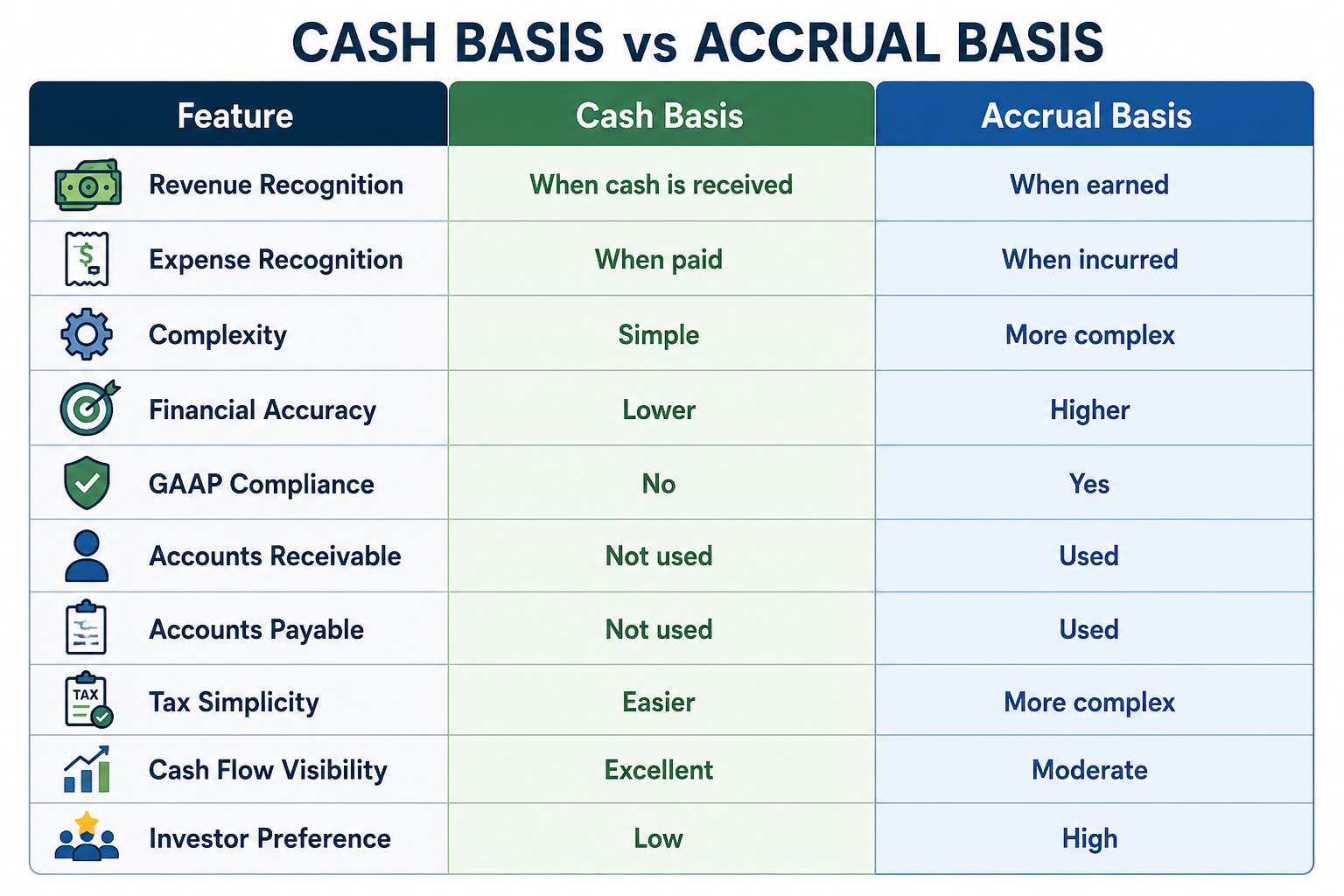
Detailed Example Comparing Both Methods
Assume a marketing agency performs services worth $10,000 in December.
The client pays in January.
The agency also receives a $3,000 vendor bill in December but pays it in January.
Cash Basis Result
December:
Revenue = $0
Expense = $0
Profit = $0
January:
Revenue = $10,000
Expense = $3,000
Profit = $7,000
Accrual Basis Result
December:
Revenue = $10,000
Expense = $3,000
Profit = $7,000
January:
Revenue = $0
Expense = $0
Profit = $0
The accrual method better reflects the actual business activity that occurred in December.
Understanding the Matching Principle
The matching principle is a fundamental concept in accrual accounting.
It states that expenses should be recognized in the same period as the revenues they help generate.
Example
A company spends $2,000 on advertising in March and generates $15,000 in sales from that campaign during March.
Under accrual accounting:
- Advertising expense is recorded in March.
- Related revenue is recorded in March.
This provides a clear picture of profitability.
Under cash accounting, payment timing could distort results.
Tax Implications of Cash vs. Accrual Accounting
Taxes are one of the biggest considerations when selecting an accounting method.
Cash Basis Taxation
Income is taxed when received.
Expenses are deducted when paid.
This may provide flexibility for tax planning.
Accrual Basis Taxation
Income is taxed when earned.
Expenses are deducted when incurred.
Businesses may owe taxes on revenue before customers actually pay invoices.
This is an important cash flow consideration.
IRS Rules for Accounting Methods
The Internal Revenue Service (IRS) allows many small businesses to use either method.
However, certain businesses may be required to use accrual accounting depending on:
- Revenue levels
- Inventory requirements
- Business structure
- Industry regulations
Businesses should consult a qualified CPA or tax advisor to determine eligibility and compliance requirements.
Businesses Best Suited for Cash Basis Accounting
Cash accounting often works well for:
Freelancers
Examples include:
- Writers
- Designers
- Consultants
- Virtual assistants
Sole Proprietors
Small owner-operated businesses with limited transactions.
Independent Contractors
Professionals who receive payments directly from clients.
Small Service Businesses
Examples:
- Cleaning services
- Local repair businesses
- Tutors
- Coaches
These businesses often have straightforward financial operations.
Businesses Best Suited for Accrual Basis Accounting
While cash basis accounting works well for many small businesses, accrual accounting is often the preferred choice for organizations that have more complex operations, significant growth plans, or external reporting requirements.
Growing Businesses
As a company expands, it becomes increasingly important to track revenue and expenses accurately.
Growing businesses often have:
- Multiple customers
- Outstanding invoices
- Vendor credit arrangements
- Long-term contracts
Accrual accounting provides a clearer understanding of financial performance.
Businesses Seeking Investors
Investors typically want detailed financial statements that accurately reflect business activity.
Accrual accounting helps investors evaluate:
- Revenue trends
- Profitability
- Operating margins
- Future growth potential
Because of this, venture capital firms and private investors generally prefer accrual-based financial statements.
Businesses Applying for Loans
Banks often require financial statements prepared under accrual accounting.
Lenders use these reports to assess:
- Repayment ability
- Financial stability
- Debt management
- Profitability trends
Accrual accounting offers a more complete picture than cash accounting.
Companies with Inventory
Businesses that buy and sell products often benefit from accrual accounting because inventory transactions can significantly affect profitability.
Examples include:
- Retail stores
- E-commerce businesses
- Manufacturing companies
- Wholesale distributors
Accrual accounting allows inventory costs to be matched with related sales.
Corporations and Larger Organizations
Many medium-sized and large companies use accrual accounting because it aligns with professional accounting standards and supports strategic decision-making.
Industry Examples: Cash Basis vs. Accrual Basis
Understanding how different industries use accounting methods can help business owners make informed decisions.
Example 1: Freelance Graphic Designer
A freelance designer completes projects and receives payment directly from clients.
Characteristics:
- Minimal inventory
- Few expenses
- Simple operations
Recommended Method:
Cash Basis Accounting
Reason:
The simplicity of cash accounting makes it easier to manage finances without extensive bookkeeping.
Example 2: Construction Company
Construction businesses often work on projects that last several months or even years.
Characteristics:
- Progress billing
- Long-term contracts
- Multiple subcontractors
Recommended Method:
Accrual Accounting
Reason:
Revenue and expenses should be recognized when earned and incurred to accurately measure project profitability.
Example 3: Online Retail Store
An e-commerce business sells products nationwide.
Characteristics:
- Inventory management
- Shipping expenses
- Customer receivables
Recommended Method:
Accrual Accounting
Reason:
Inventory tracking and revenue matching are essential for understanding profitability.
Example 4: Local Landscaping Service
A small landscaping company provides services and receives payment shortly after completing jobs.
Characteristics:
- Limited inventory
- Simple transactions
- Local customer base
Recommended Method:
Cash Basis Accounting
Reason:
The business can effectively monitor cash flow without complex accounting procedures.
Example 5: Software-as-a-Service (SaaS) Company
A SaaS company sells annual subscriptions to customers.
Characteristics:
- Recurring revenue
- Deferred revenue
- Long-term contracts
Recommended Method:
Accrual Accounting
Reason:
Revenue must be recognized over the service period rather than when payment is received.
Impact on Financial Statements
One of the biggest differences between cash and accrual accounting is how financial statements appear.
Income Statement
Cash Basis Income Statement
Includes:
- Cash received from customers
- Cash paid for expenses
Does not include:
- Unpaid invoices
- Outstanding bills
Accrual Basis Income Statement
Includes:
- Revenue earned
- Expenses incurred
Provides a more accurate view of profitability.
Balance Sheet
Cash Basis Accounting
Balance sheets are often less informative because they exclude many receivables and payables.
Accrual Accounting
Balance sheets include:
- Accounts receivable
- Accounts payable
- Accrued expenses
- Deferred revenue
This provides a comprehensive picture of financial position.
Cash Flow Statement
Cash flow statements remain important under both methods.
However, under accrual accounting, the cash flow statement becomes critical because profits may differ significantly from cash availability.
For example:
A business may report $100,000 in profit but have only $20,000 in cash because customers have not yet paid invoices.
Transitioning from Cash Basis to Accrual Basis
Many businesses begin with cash accounting and later transition to accrual accounting as they grow.
The process requires careful planning.
Step 1: Analyze Current Financial Records
Review:
- Outstanding customer invoices
- Vendor bills
- Inventory balances
- Prepaid expenses
This information will be needed for conversion.
Step 2: Record Accounts Receivable
Any unpaid customer invoices must be added to the accounting records.
This ensures earned revenue is properly recognized.
Step 3: Record Accounts Payable
Outstanding vendor obligations must also be recorded.
This allows expenses to be matched with the period in which they were incurred.
Step 4: Adjust Inventory
Inventory balances must be established and tracked accurately.
Inventory is a critical component of accrual accounting for product-based businesses.
Step 5: Update Accounting Software
Most modern accounting systems support both methods.
Businesses should configure software to properly track:
- Receivables
- Payables
- Inventory
- Accrual adjustments
Step 6: Consult a CPA
Switching accounting methods may require IRS approval in certain situations.
A Certified Public Accountant can help ensure compliance and accuracy.
Common Mistakes Businesses Make
Understanding common accounting mistakes can help avoid costly errors.
Mistake 1: Confusing Profit with Cash
Many business owners assume that profit equals available cash.
This is not always true.
A profitable company can still experience cash flow problems.
Mistake 2: Ignoring Outstanding Invoices
Businesses using cash accounting may overlook unpaid customer invoices.
This can lead to inaccurate assessments of business performance.
Mistake 3: Failing to Track Payables
Outstanding vendor obligations should be monitored carefully.
Ignoring future liabilities can create financial surprises.
Mistake 4: Using the Wrong Method for Growth Stage
A method that works for a startup may not work for a growing company.
Business owners should periodically evaluate whether their accounting method still meets their needs.
Mistake 5: Poor Recordkeeping
Regardless of the accounting method used, maintaining accurate records is essential.
Good recordkeeping supports:
- Tax compliance
- Financial reporting
- Business decision-making
Cash Basis vs. Accrual Basis: Which Is Better?
There is no universal answer.
The best accounting method depends on your business model, size, growth objectives, and reporting needs.
Cash Basis May Be Better If:
- You operate a small business.
- You have limited transactions.
- You want simple bookkeeping.
- Cash flow visibility is your primary concern.
- You do not require complex financial reporting.
Accrual Basis May Be Better If:
- You have inventory.
- You issue many invoices.
- You need financing.
- You plan to attract investors.
- You want detailed financial insights.
- Your business is growing rapidly.
Quick Comparison Summary
| Factor | Cash Basis | Accrual Basis |
| Simplicity | High | Moderate |
| Accuracy | Moderate | High |
| Tax Flexibility | High | Moderate |
| Growth Readiness | Limited | Excellent |
| Investor Acceptance | Low | High |
| Loan Applications | Less Preferred | Preferred |
| Inventory Management | Limited | Strong |
| Financial Reporting | Basic | Comprehensive |
| Setup Cost | Lower | Higher |
| Long-Term Scalability | Lower | Higher |
Frequently Asked Questions (FAQs)
Is cash basis accounting allowed in the United States?
Yes. Many small businesses in the United States are permitted to use cash basis accounting, subject to IRS requirements.
Which accounting method is easier?
Cash basis accounting is generally easier because transactions are recorded only when cash is received or paid.
Why do investors prefer accrual accounting?
Accrual accounting provides a more accurate representation of financial performance and future obligations.
Can a business switch accounting methods later?
Yes. Many businesses start with cash accounting and transition to accrual accounting as they grow.
Does accrual accounting improve profitability?
No. It does not change profitability. It changes when revenue and expenses are recognized, resulting in more accurate financial reporting.
Is accrual accounting required for GAAP compliance?
Yes. Generally Accepted Accounting Principles (GAAP) primarily rely on accrual accounting.
Which accounting method is best for freelancers?
Most freelancers benefit from cash basis accounting because of its simplicity and ease of use.
Which method is best for e-commerce businesses?
Accrual accounting is typically more suitable because it supports inventory management and accurate profit measurement.
Final Thoughts
Choosing between cash basis and accrual basis accounting is one of the most important financial decisions a business owner can make. The right choice affects tax reporting, financial analysis, cash flow management, investor relations, and long-term growth.
Cash basis accounting offers simplicity and clear visibility into cash flow, making it attractive for freelancers, sole proprietors, and small service-based businesses. It is easy to understand and requires less administrative effort.
Accrual accounting, on the other hand, provides a more complete and accurate picture of business performance. By recognizing revenue when earned and expenses when incurred, it enables better decision-making, supports growth, and aligns with professional accounting standards.
For many startups and small businesses, cash accounting may be the ideal starting point. However, as operations become more complex, transitioning to accrual accounting can provide valuable financial insights and position the business for long-term success.
Before selecting an accounting method, evaluate your business goals, reporting requirements, growth plans, and tax considerations. Consulting a qualified CPA or accounting professional can help ensure you choose the approach that best supports your organization’s future.
