
Cash flow is the lifeblood of every business. No matter how many sales a company generates, the business can struggle financially if customers do not pay their invoices on time. This is where the Accounts Receivable (AR) process becomes critical.
Accounts receivable refers to the money owed to a business by customers who have purchased goods or services on credit. An efficient AR process helps businesses maintain healthy cash flow, reduce bad debts, improve customer relationships, and ensure financial stability.
For companies across the United States, managing accounts receivable effectively is no longer optional. Businesses face increasing pressure to shorten payment cycles, reduce collection costs, and improve working capital management.
In this comprehensive guide, we will explain the accounts receivable process step by step, provide practical examples, discuss common challenges, and share best practices to help businesses optimize their AR operations.
What Is Accounts Receivable?
Accounts Receivable (AR) represents the outstanding invoices a company has or the money customers owe for products or services delivered on credit.
When a company sells a product or service and allows the customer to pay later, the amount becomes an accounts receivable asset on the balance sheet.
Simple Example
A marketing agency provides digital marketing services worth $10,000 to a client and issues a 30-day invoice. The client receives the service today but pays after 30 days. Until payment is received, the $10,000 is recorded as accounts receivable.
Why Is the Accounts Receivable Process Important?
The accounts receivable (AR) process plays a critical role in the financial health of any business. While sales are essential for generating revenue, a sale is not truly complete until the payment is collected. Many businesses focus heavily on increasing sales but overlook the importance of collecting payments efficiently. A strong accounts receivable process ensures that the company receives the money it has earned, allowing it to meet financial obligations and continue growing.
Without an effective AR process, businesses may experience cash flow shortages, delayed vendor payments, increased borrowing costs, and higher risks of bad debt. On the other hand, organizations that actively manage their receivables can improve liquidity, reduce financial risk, and create a stronger foundation for long-term success.
The following are some of the key benefits of a well-structured accounts receivable process.
Improve Cash Flow
Cash flow is often referred to as the lifeblood of a business. Even profitable companies can struggle if they do not receive payments from customers on time. The accounts receivable process helps businesses track outstanding invoices, follow up on overdue payments, and ensure that cash enters the organization as quickly as possible.
For example, imagine a manufacturing company that sells $500,000 worth of products every month on credit terms. If customers consistently delay payments by 30 to 60 days beyond the due date, the company may face difficulties paying employees, purchasing inventory, or covering operating expenses. An efficient AR process reduces these delays and keeps cash flowing into the business.
Improved cash flow provides businesses with greater flexibility, allowing them to invest in growth opportunities, expand operations, and handle unexpected expenses without relying heavily on external financing.
Reduce Overdue Payments
Late payments are one of the most common challenges faced by businesses across all industries. When invoices are not monitored properly, customers may forget payment deadlines or prioritize payments to other suppliers.
A structured accounts receivable process includes proactive monitoring, automated reminders, and timely follow-ups. These measures encourage customers to make payments on time and help reduce the number of overdue accounts.
For example, a company may send payment reminder emails seven days before an invoice is due, on the due date itself, and again if the payment becomes overdue. Such systematic communication significantly improves collection rates and reduces payment delays.
Reducing overdue payments helps businesses maintain a steady cash flow and decreases the amount of time employees spend chasing unpaid invoices.
Minimize Bad Debts
Bad debts occur when customers fail to pay the money they owe and the business eventually writes off the outstanding balance as a loss. Every bad debt directly impacts profitability and can create significant financial challenges.
An effective AR process minimizes bad debts by implementing strong credit controls and ongoing customer monitoring. Before extending credit, businesses can assess a customer’s financial history, credit score, payment behavior, and financial stability.
For example, if a customer has a history of late payments or financial difficulties, the company may decide to require partial upfront payment or reduce the customer’s credit limit.
Regular monitoring of outstanding accounts also helps identify high-risk customers early, allowing businesses to take corrective action before unpaid balances become uncollectible.
Maintain Customer Relationships
Many business owners assume that collections activities damage customer relationships. In reality, a professional and organized accounts receivable process can strengthen customer relationships by promoting transparency and communication.
Customers appreciate accurate invoices, clear payment terms, prompt responses to billing inquiries, and professional follow-up procedures. When issues arise, a well-managed AR team can resolve disputes quickly and maintain positive relationships.
For example, if a customer disputes an invoice because of a pricing discrepancy, a responsive AR department can investigate the issue promptly and provide clarification. Resolving concerns efficiently builds trust and demonstrates professionalism.
Strong customer relationships often lead to repeat business, referrals, and long-term partnerships that benefit both parties.
Increase Profitability
Profitability depends not only on generating revenue but also on collecting it efficiently. When payments are delayed, businesses may incur additional collection costs, interest expenses, and administrative overhead.
An effective AR process helps organizations convert sales into cash more quickly, reducing financing costs and improving overall profitability.
For example, a company that consistently collects invoices within 30 days may avoid taking short-term loans to cover operational expenses. By reducing borrowing costs and minimizing bad debt losses, the company retains more of its earnings.
Faster collections also allow businesses to reinvest funds into growth initiatives that generate additional revenue and profits.
Improve Financial Forecasting
Accurate financial forecasting is essential for making informed business decisions. Business leaders need reliable information about future cash inflows to plan budgets, investments, hiring decisions, and expansion strategies.
A well-managed accounts receivable process provides greater visibility into expected cash collections and customer payment patterns. AR aging reports, collection metrics, and payment histories help finance teams predict future cash flow more accurately.
For example, if a business knows that most customers pay within 35 days, it can estimate future cash inflows with greater confidence and make better financial decisions.
Improved forecasting reduces uncertainty and helps organizations prepare for both opportunities and challenges.
Support Business Growth
Growth requires financial resources. Whether a company wants to hire new employees, purchase equipment, expand into new markets, or launch new products, sufficient cash is necessary to support those initiatives.
An efficient accounts receivable process accelerates cash collections and improves liquidity, providing businesses with the resources they need to grow.
For example, a software company experiencing rapid sales growth may struggle to fund operations if customers consistently pay late. By optimizing its AR process and reducing collection times, the company can access cash more quickly and support expansion without excessive borrowing.
Businesses with strong receivables management are often better positioned to seize growth opportunities when they arise.
Strengthen Working Capital Management
Working capital represents the difference between a company’s current assets and current liabilities. Effective working capital management is essential for maintaining financial stability and operational efficiency.
Accounts receivable is one of the most significant components of working capital. The faster a company converts receivables into cash, the stronger its working capital position becomes.
For example, consider two businesses with identical annual revenue. The first company collects payments within 30 days, while the second takes 75 days to collect. The first company will generally have more cash available for daily operations, investments, and emergency situations.
Strong working capital management helps businesses reduce financial stress, improve operational efficiency, and maintain a competitive advantage in the marketplace.
The Strategic Value of Accounts Receivable Management
Many organizations view accounts receivable as a routine accounting function. However, effective AR management is a strategic business activity that directly influences cash flow, profitability, customer satisfaction, and long-term growth.
A company that consistently collects payments on time can invest more confidently in its future, while businesses with weak AR processes often struggle despite generating strong sales.
In today’s competitive business environment, organizations that prioritize accounts receivable management gain a significant financial advantage. By implementing clear credit policies, accurate invoicing procedures, proactive collections strategies, and modern automation tools, businesses can transform their accounts receivable process into a powerful driver of financial success.
Overview of the Accounts Receivable Process
The accounts receivable process typically includes the following steps: Each step plays a crucial role in ensuring timely payment collection.
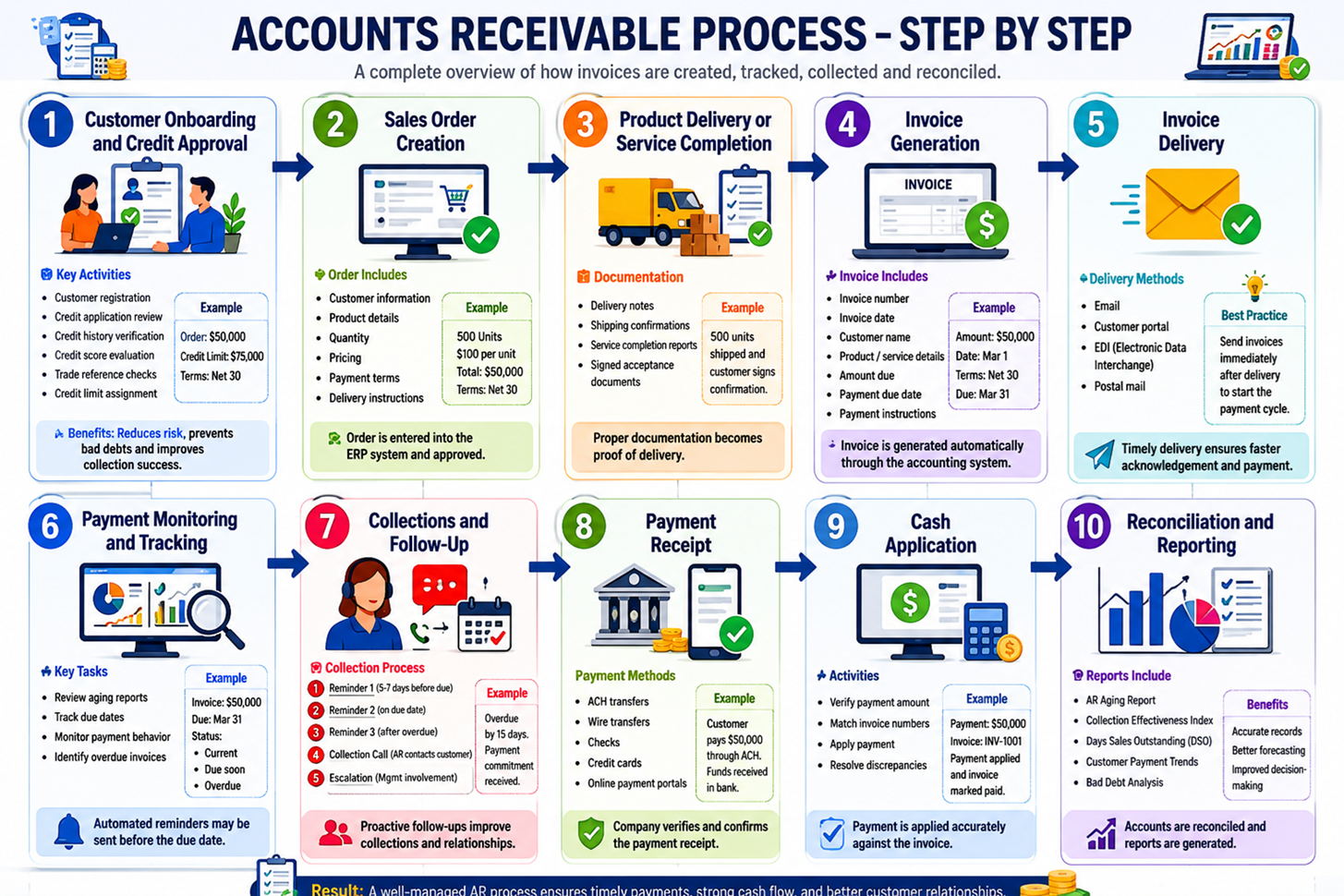
Step 1: Customer Onboarding and Credit Approval
Before extending credit, businesses must evaluate the customer’s financial reliability.
Activities Involved
- Customer registration
- Credit application review
- Credit history verification
- Credit score evaluation
- Trade reference checks
- Credit limit assignment
Example
ABC Manufacturing receives an order worth $50,000 from a new customer.
Before approving credit terms, the finance department reviews:
- Credit reports
- Bank references
- Trade references
- Financial statements
The customer is approved with a $75,000 credit limit and Net 30 payment terms.
Benefits
- Reduces payment risk
- Prevents bad debts
- Improves collection success
Step 2: Sales Order Processing
Once credit approval is completed, the sales team creates a sales order.
The sales order includes:
- Customer information
- Product details
- Quantity
- Pricing
- Payment terms
- Delivery instructions
The order is reviewed and approved before fulfillment.
Example
ABC Manufacturing receives an order for:
- 500 units
- $100 per unit
- Total order value: $50,000
- Payment terms: Net 30
The order is entered into the ERP system.
Step 3: Product Delivery or Service Completion
The business fulfills the order by delivering products or completing services.
Supporting documentation may include:
- Delivery notes
- Shipping confirmations
- Service completion reports
- Signed acceptance documents
Proper documentation reduces future invoice disputes.
Example
The warehouse ships all 500 units.
The customer signs the delivery confirmation.
This document becomes proof of delivery.
Step 4: Invoice Generation
After delivery, the company generates an invoice.
The invoice should contain:
- Invoice number
- Invoice date
- Customer name
- Product or service details
- Amount due
- Payment due date
- Payment instructions
Example
Invoice Amount: $50,000
Invoice Date: March 1
Payment Terms: Net 30
Due Date: March 31
The invoice is generated automatically through the accounting system.
Step 5: Invoice Delivery
The invoice must reach the customer promptly.
Common delivery methods include:
- Customer portal
- Electronic Data Interchange (EDI)
- Postal mail
Many businesses use automated invoicing systems to ensure timely delivery.
Best Practice
Send invoices immediately after delivery.
The sooner the invoice is received, the sooner the payment cycle begins.
Step 6: Payment Monitoring and Tracking
After invoicing, the AR team monitors outstanding balances.
Key tasks include:
- Reviewing aging reports
- Tracking due dates
- Monitoring customer payment behavior
- Identifying overdue invoices
Example
Outstanding Invoice: $50,000
Due Date: March 31
Status Tracking:
- Current
- Due soon
- Overdue
Automated reminders may be sent before the due date.
Step 7: Collections and Follow-Up
When invoices become overdue, collection activities begin.
Collection Process
Reminder 1: Sent 5–7 days before due date.
Reminder 2: Sent on due date.
Reminder 3: Sent after payment becomes overdue.
Collection Call: AR representative contacts customer.
Escalation: Management involvement if necessary.
Example
Invoice overdue by 15 days.
AR specialist contacts the customer.
Customer reports invoice approval delay.
Payment commitment is obtained for the following week.
Step 8: Payment Receipt
Customers make payments using various methods.
Common payment methods include:
- ACH transfers
- Wire transfers
- Checks
- Credit cards
- Online payment portals
The company verifies payment receipt.
Example
Customer transfers $50,000 through ACH.
Funds are deposited into the company bank account.
Step 9: Cash Application
Cash application is the process of matching received payments with outstanding invoices.
Activities
- Verify payment amount
- Match invoice numbers
- Apply payment
- Resolve discrepancies
Example
Payment Received: $50,000
Invoice Number: INV-1001
The AR team applies payment against the invoice and marks it paid.
Step 10: Reconciliation and Reporting
The final stage involves reconciling accounts and generating reports.
Reports may include:
- AR Aging Report
- Collection Effectiveness Index
- Days Sales Outstanding (DSO)
- Customer Payment Trends
- Bad Debt Analysis
Benefits
- Accurate financial records
- Better cash flow forecasting
- Improved decision-making
Complete Accounts Receivable Example
Suppose ABC Electronics, a manufacturer of consumer electronics, receives an order from XYZ Retail, a large retail chain, for products worth $20,000. On January 1, XYZ Retail places the order and requests standard credit terms. Before processing the order, ABC Electronics performs a credit review to assess the customer’s financial reliability and payment history. After completing the review, the company’s finance department approves the credit request on January 2 and assigns Net 30 payment terms.
Once the credit approval is received, ABC Electronics proceeds with fulfilling the order. On January 5, the products are shipped to XYZ Retail, and the company generates an invoice for $20,000 on the same day. The invoice clearly specifies the payment terms, indicating that the payment is due within 30 days from the invoice date. This means the payment due date is February 4.
After sending the invoice, the accounts receivable team begins monitoring the outstanding balance. As part of its standard collection procedure, the company sends a friendly payment reminder to XYZ Retail on February 1, a few days before the invoice becomes due. The reminder helps ensure that the invoice remains visible to the customer’s accounts payable department and reduces the likelihood of late payment.
Upon receiving the reminder, XYZ Retail reviews the invoice and schedules payment. On February 3, one day before the due date, the customer initiates an ACH (Automated Clearing House) payment for the full invoice amount of $20,000. The funds are successfully transferred and received by ABC Electronics on February 4, the invoice due date.
Once the payment is received, the accounts receivable team verifies the transaction and matches the payment to the corresponding invoice. On February 5, the payment is applied to the customer’s account, the invoice is marked as paid, and the account is reconciled. The transaction is then recorded in the company’s accounting system, ensuring that financial records remain accurate and up to date.
Common Challenges in the Accounts Receivable Process
Late Payments
Late payments occur when customers do not settle their invoices within the agreed payment terms. This can create cash flow challenges for businesses and increase the time and effort required for collections. Regular payment reminders and proactive follow-ups can help reduce payment delays.
Invoice Errors
Invoice errors such as incorrect amounts, missing information, or inaccurate billing details can lead to payment delays and customer dissatisfaction. Ensuring invoice accuracy before sending it to customers helps prevent disputes and accelerates the payment process.
Manual Processes
Businesses that rely heavily on manual data entry often face higher risks of errors and inefficiencies. Manual processes can slow down invoicing, payment tracking, and reconciliation activities. Automating accounts receivable tasks can improve accuracy and save valuable time.
Disputes
Customers may dispute invoices due to concerns about pricing, product quality, quantities delivered, or service performance. These disputes often delay payments until the issue is resolved. Maintaining clear documentation and communication can help minimize disputes.
Poor Communication
A lack of communication between the business and its customers can result in missed payments and unresolved billing issues. Timely reminders, prompt responses to inquiries, and regular follow-ups help keep payments on track and strengthen customer relationships.
High Days Sales Outstanding (DSO)
A high Days Sales Outstanding (DSO) indicates that a company is taking longer to collect payments from customers. Extended collection periods can negatively impact cash flow and working capital. Monitoring DSO regularly helps businesses identify collection issues and improve payment performance.
Best Practices for Effective Accounts Receivable Management
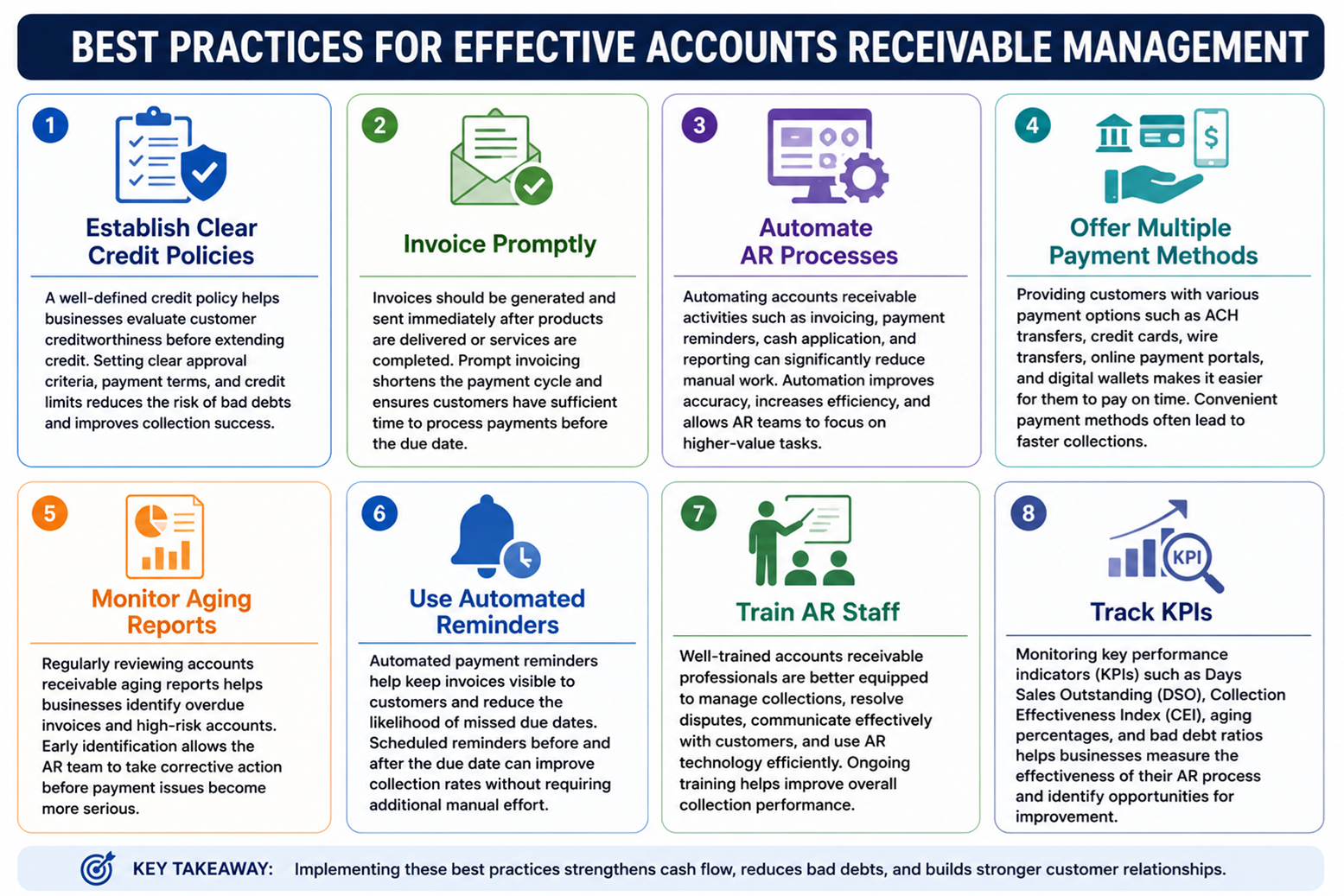
Establish Clear Credit Policies
A well-defined credit policy helps businesses evaluate customer creditworthiness before extending credit. Setting clear approval criteria, payment terms, and credit limits reduces the risk of bad debts and improves collection success.
Invoice Promptly
Invoices should be generated and sent immediately after products are delivered or services are completed. Prompt invoicing shortens the payment cycle and ensures customers have sufficient time to process payments before the due date.
Automate AR Processes
Automating accounts receivable activities such as invoicing, payment reminders, cash application, and reporting can significantly reduce manual work. Automation improves accuracy, increases efficiency, and allows AR teams to focus on higher-value tasks.
Offer Multiple Payment Methods
Providing customers with various payment options such as ACH transfers, credit cards, wire transfers, online payment portals, and digital wallets makes it easier for them to pay on time. Convenient payment methods often lead to faster collections.
Monitor Aging Reports
Regularly reviewing accounts receivable aging reports helps businesses identify overdue invoices and high-risk accounts. Early identification allows the AR team to take corrective action before payment issues become more serious.
Use Automated Reminders
Automated payment reminders help keep invoices visible to customers and reduce the likelihood of missed due dates. Scheduled reminders before and after the due date can improve collection rates without requiring additional manual effort.
Train AR Staff
Well-trained accounts receivable professionals are better equipped to manage collections, resolve disputes, communicate effectively with customers, and use AR technology efficiently. Ongoing training helps improve overall collection performance.
Track KPIs
Monitoring key performance indicators (KPIs) such as Days Sales Outstanding (DSO), Collection Effectiveness Index (CEI), aging percentages, and bad debt ratios helps businesses measure the effectiveness of their AR process and identify opportunities for improvement.
Important Accounts Receivable KPIs
Days Sales Outstanding (DSO)
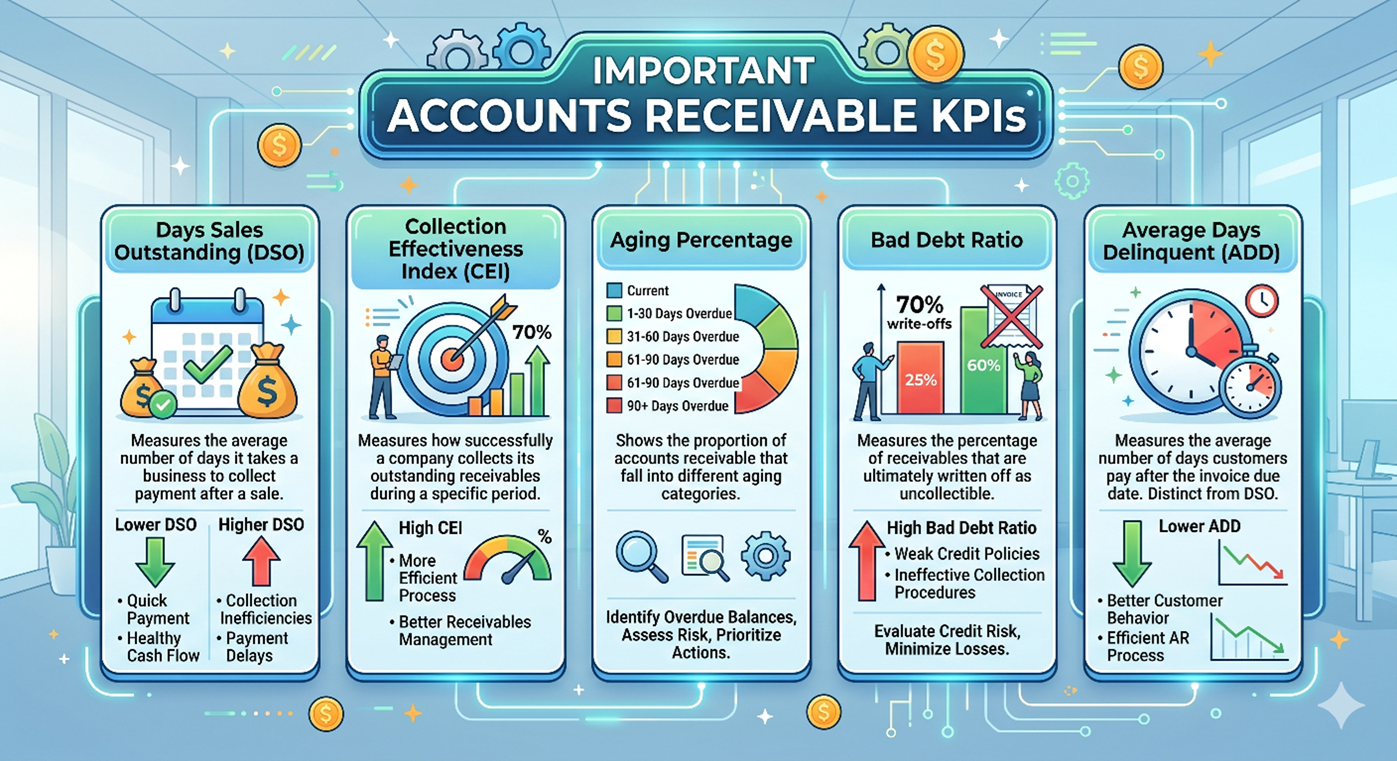
Days Sales Outstanding (DSO) measures the average number of days it takes a business to collect payment after a sale has been made. A lower DSO indicates that customers are paying quickly, while a higher DSO may signal collection inefficiencies or payment delays. Monitoring DSO helps businesses assess the effectiveness of their accounts receivable process and maintain healthy cash flow.
Collection Effectiveness Index (CEI)
The Collection Effectiveness Index (CEI) measures how successfully a company collects its outstanding receivables during a specific period. A higher CEI indicates a more efficient collection process and better overall receivables management. This KPI helps organizations evaluate the performance of their collection efforts and identify areas for improvement.
Aging Percentage
Aging Percentage shows the proportion of accounts receivable that fall into different aging categories, such as current, 30 days overdue, 60 days overdue, or 90+ days overdue. This metric helps businesses identify overdue balances, assess collection risks, and prioritize follow-up actions on outstanding invoices.
Bad Debt Ratio
The Bad Debt Ratio measures the percentage of receivables that are ultimately written off as uncollectible. A high bad debt ratio may indicate weak credit policies or ineffective collection procedures. Tracking this KPI helps businesses evaluate credit risk and minimize financial losses from unpaid invoices.
Average Days Delinquent (ADD)
Average Days Delinquent (ADD) measures the average number of days customers pay after the invoice due date. Unlike DSO, which focuses on overall collection time, ADD specifically highlights payment delays. A lower ADD indicates better customer payment behavior and a more efficient accounts receivable process.
How Technology Is Transforming Accounts Receivable
Modern AR software offers:
- Automated invoicing
- AI-powered collections
- Customer portals
- Automated reminders
- Real-time reporting
- Payment matching
- Predictive analytics
Automation helps businesses reduce costs while improving cash flow.
Conclusion
The accounts receivable process is much more than sending invoices and collecting payments. It is a structured workflow that directly impacts cash flow, profitability, customer relationships, and business growth.
Organizations that implement strong credit controls, accurate invoicing, proactive collections, and modern automation tools can significantly improve their financial performance.
By following the step-by-step accounts receivable process outlined in this guide, businesses can reduce payment delays, lower bad debt risk, strengthen working capital, and create a more predictable cash flow environment.
An efficient accounts receivable process is not just an accounting function—it is a strategic advantage that supports long-term business success.
